Great Ellingham, Norfolk, England
Place research page generated from the structured place spine and the companion place markdown.
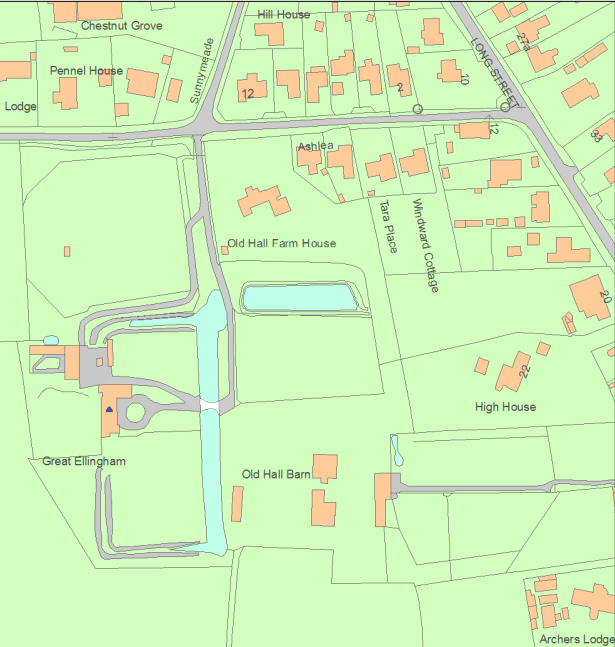
Great Ellingham manor, later associated with the Lovell inheritance through Margaret Lovell; Norfolk Heritage Explorer identifies Old Hall (NHER 9108) as a medieval moated manorial site with a mid-16th-century great house, said to be 1573 by Henry Gurney, on the site of an earlier moated manor.
Linked ancestors
- G15 Henry Gurnay landholding / property reference
- G15 Henry Gurnay individual geography
- G16 Francis Gurney landholding / property reference
- G17 Anthony Gurney landholding / property reference
- G17 Anthony Gurney individual geography
Village in south-central Norfolk. Current site coordinate: 52.528994, 0.970243 (high accuracy). Broader village coordinate formerly used: 52.5453, 1.0091774978679044.
One of the most important later Norfolk manorial records in the family, because it entered the Gurneys through the Lovell inheritance and remained a meaningful family holding into the seventeenth century.
Great Ellingham’s Gurney current site is best represented by Old Hall / Old Hall Farmhouse: a medieval moated manorial site with a mid-sixteenth-century great house within the main moat, additional moated enclosures and fishponds, two listed barns, and Grade II listed Old Hall Farmhouse. The current-site / extant-status summary should be: house and two barns exist plus medieval-era moat and ponds.[1][2]
Why this place matters structurally
Great Ellingham is not a medieval origin-place of the junior line in the way Harpley or Hardingham are. Its importance is different: it shows the family gaining stature and property through a Tudor inheritance and marriage network, especially through Margaret Lovell, wife of Anthony Gurney (G17). In the normalized place set, Great Ellingham helps explain the family’s later Norfolk gentry position, just as Harpley and Hardingham explain the older medieval base. [Blomefield] [Anthony G17 companion] [Henry G15 companion]
The place also matters because the record remains unusually traceable after Henry Gurney (G15). Blomefield follows the manor forward through Henry’s grandson Edward Gurney, then to the younger Henry who died without issue in 1661, and finally out of the surname through Margaret Gurney Davy and Mary Davy Potts. That makes Great Ellingham one of the clearest places in which the family can be seen both acquiring and eventually losing a manor through female-line succession. [Blomefield]
A Norwich Consistory Court act-book entry, now imaged and expert-read, anchors a Gurnay household at Great Ellingham more than a century before the documented Lovell inheritance through Margaret Lovell brought the manor into Anthony Gurney’s (G17) household: on 5 August 1454 administration of the goods of Thomas Gurnay, late of Great Ellingham (“Thome Gurnay nuper de Elyngham magna”), dying intestate, was committed to Alice his widow (“Alicie relicte dicti defuncti”) and a co-administrator Thomas A[p]pulton of an unresolved D-place (the bracketed surname is crossed by the entry’s cancellation stroke). The entry gives no status word for the deceased and no further family detail.[3] This Thomas does not match G20 Thomas Gournay II (alive until 1471, Harpley/West Barsham seat — the 1454 death also removes the Great Ellingham man from the candidates for the January 1463 “clerk convict” episode worked on the Norwich collateral topic) or G21 Thomas Gournay I (dead before 1444), and his widow Alice is distinct from the 1434 “Alice, formerly wife of William Gurnay” of Heigham below — two mid-century Gurnay widows named Alice. Identity, descent, and any relationship to the later Lovell-inherited manor are not established.
A second mid-fifteenth-century Norwich Consistory Court record fits the same pre-Lovell pattern in the adjacent parish: the 1465 will of Joan Gurney (Gurnay) of Deopham, register Cobald 55 — Deopham (Depham) borders Great Ellingham and sits inside the same later Lovell estate cluster (Deopham, Morley, Little Ellingham, Hingham, Attleborough).[4] The same register Cobald also recorded, in 1465, a small legacy by John Gurney of Filby (in east Norfolk, near Yarmouth) for the chapel of St John there (folio 30); Daniel Gurney filed that John under the heading “Cotemporary,” i.e. an unplaced collateral rather than a direct-line ancestor.[5] Joan’s 1465 will is not that of Robert Gournay’s (G22) wife Joan de Norwich, despite the surname coincidence: Robert died c. 1420, so his widow would have been roughly ninety and some forty-five years widowed by 1465. Taken together, the 1454 Thomas and 1465 Joan point to a distinct central-Norfolk Gurnay presence around Great Ellingham and Deopham two to three generations before the Lovell inheritance reached the West Barsham line; their identity and any relationship to the main line are not established.
Two further Norwich Consistory Court wills push this dispersed pre-Lovell Gurnay presence back another two generations and out to the Norwich suburbs. The earliest is the 1373 will of John Gurney (Gernays), chaplain of Loddon, Holy Trinity (register Heydon, 32) — contemporary with the direct line’s Edmund Gournay (G23, d. 1387) but, as a chaplain, necessarily a collateral.[6] The second is the 1434 will of Alice Gurnay, widow of William Gurnay of Heigham juxta Norwich (register Surflete, 162) — a named Gurnay marriage in the Norwich suburb of Heigham, three generations before the Lovell inheritance.[7] Neither will text has been read yet; the catalogue gives register, folio, date, and identity. With the 1454 Thomas, the 1465 Joan of Deopham, and John of Filby, they sketch a Gurnay collateral presence threaded across south-central and eastern Norfolk — Loddon, Heigham, Great Ellingham, Deopham, Filby — from the 1370s onward, well before the West Barsham line acquired Great Ellingham. Several of these mid-fifteenth-century Norwich Consistory Gurney wills are now reachable as images in FamilySearch Full-Text — the image-read step previously outstanding: an authenticated broad-variant sweep surfaces a John Gurnee will (1444–54, ark 3:1:3Q9M-CSND-39LW-3), an Antonette Gurnee will (1454–64, ark 3:1:3Q9M-CSND-NTYT), and two further Gurne/Gurnee wills (1444–54, arks 3:1:3Q9M-CSND-39LF-F and 3:1:3Q9M-CSND-39L6-P). The transcripts are court-hand salad, so matching a given ark to a specific catalogued testator (Aleyn 19, Cobald 55, or John of Filby) needs the image reads. “Antonette Gurnee” is not among the catalogued testators above and may be an additional fifteenth-century Norfolk Gurney — verify against the Index to Wills, Consistory Court of Norwich 1370–1550.[8]
A clean-OCR sweep of the Bradfer-Lawrence Norfolk will-abstracts adds four later, geographically dispersed Gurnay sightings of the same unplaced-collateral character, recorded here so they are not lost: a testator’s “brother John Gurney(s) of Kenton” (Kenton, Suffolk) named executor, in a will abstracted under 1514–17; a testator’s “sister Joan Gurney and her children” (1606); an “Elizabeth Gournay” among a testator’s sisters (1654); and a “nephew Gourney Crowe” of East Bilney (1683), the forename Gourney itself onomastic evidence of an earlier Crowe–Gurney marriage. None is yet tied to the West Barsham line or to one another; they are logged as collateral sightings for future tracing.[9]
A printed calendar of medieval Norfolk deeds (digitised as FamilySearch image group DGS 004389182; clean OCR) adds two further medieval Gurnay landholding sightings in the same dispersed central-Norfolk/Norwich pattern: a tenement of John Gurnay at St George at Gates, Norwich, recited alongside Giles le Armourer and Margaret (formerly wife of John Lungespe); and “Gurnay, Elys, [and] John Stuteville, of E[llingham], … Trustees” of property in Somerton and Sloley. The “of E.” (Ellingham) trustee tag places this Gurnay in the same Great Ellingham orbit as the wills above, and the Stuteville/Elys co-trustees set the family in a medieval Norfolk trustee network. Calendar entry numbers (Gurnay 3, 41; John Gurnay 16) are recorded for retrieval; the calendar’s exact published title is not yet confirmed, so the deeds are held at catalogue level pending the original.[10]
The Manor (current site)
Current site / extant status: house and two barns exist plus medieval-era moat and ponds.
The site is a mostly well-preserved medieval moated manorial complex. NHER MNF9108 records the main component as surviving moats and fishponds, with additional moated enclosures and fishponds visible as either extant earthworks or partially levelled cropmarks. The house within the main moat is a mid-sixteenth-century great house, now a farmhouse.[1]
Historic England list entry 1077566 confirms the extant house component: Old Hall Farmhouse is Grade II listed, first listed 21 July 1951 and amended 16 November 1983. Historic England describes it as a c.1570 timber-framed house, now farmhouse, with wattle and daub and some clay lump infill on a brick plinth, a cross-wing plan, two storeys, a central range flanked by gabled cross wings, and an original stair surviving to the attic.[2]
NHER also records a sixteenth-century barn to the southeast and a seventeenth/eighteenth-century barn to the northwest. Together, NHER and Historic England support the site-status statement: the house and two barns exist, and the medieval-era moat and ponds survive or remain visible as earthworks/cropmarks.[1]
Gurney ancestors connected here
| Ancestor | Gen | Connection |
|---|---|---|
| Francis Gurney | G16 | Structured linkage for the transitional generation; direct topographical detail still lighter here |
| Anthony Gurney | G17 | Manor came through his wife Margaret Lovell; documented as lord in the early Tudor period |
| Henry Gurney | G15 | Lord in 1572 per Blomefield |
The Lovell–Conyers–Spelman connection
Anthony Gurney’s wife Margaret Lovell brought Great Ellingham into the family as one of the daughters and coheirs of Sir Robert Lovell by Ela Conyers. This same line linked the Gurneys into the broader Lovell and Spelman kinship network. So Great Ellingham is not only a manor record but also a visible marker of the family’s entry into a more elevated Tudor cousinage network. [Anthony G17 research companion file]
Later descent
Henry Gurney (G15) was lord in 1572. After him the manor passed through the senior West Barsham line to his grandson Edward Gurney (d. 1641), then to the younger Henry Gurney (d. 1661 without issue), and then through Margaret Gurney Davy to the Potts family. That later descent is important because it shows Great Ellingham outlasting several other named Gurney properties in active memory and remaining visible in county topography well after the surname’s direct possession ended. [Henry G15 companion]
That descent is now confirmed from the wills themselves, and the missing generation between Henry and Edward can be named. Henry’s eldest son Thomas Gurney — husband of Martha, daughter of Sir Edward Lewkenor of Denham — died in 1614 or early 1615, before his father, leaving a son and heir about five years old. Edward was therefore a minor for the whole of Henry’s last decade, and the manor passed grandfather-to-grandson in 1623 because the middle generation had already gone. Edward’s own will, proved February 1641/2, and his son Henry’s, proved February 1661, complete the sequence: Henry’s settles the estate on his wife for life with no provision for children at all, which is why the senior line ends here.[11]
Great Ellingham is also where the widow’s Chancery business lands. In 1648 Frances Gurnay, widow, and Henry Gurnay sued Edmund Cocke over property in Great Ellingham. The wills identify those parties precisely — Frances is Edward’s widow (Frances Hood), Henry the son who made the 1661 will — so the suit is the senior line litigating over this manor in the generation before it failed. The pleadings themselves are unread and would give the substance of the dispute.[12]
Two record-level anchors for Henry G15’s tenure surfaced in the NRO catalogue: his probate register row — NCC register Lawson, fo. 151, 1623, matching the probate clause of 23 October 1623 on his will images — and a pair of 1587 conveyances, RQG 180 (10 Dec 1587, “Indenture: bargain and sale. Henry Gurnay of Great Elingham, esq.”) and RQG 181 (19 Dec 1587, feoffment Henry Gurnay to Paul Gooche) — working conveyances by the Elizabethan lord styled “of Great Ellingham,” their originals unexamined.[13]
Interpretive note
This file is one of the clearest examples of how the place library should distinguish medieval family-seat logic from later inheritance logic. Great Ellingham belongs to the second category. It is a later gentry-manor and inheritance record, not a Norman or early junior-line proof-place.
Additional Property Details
-
Old Hall (NHER 9108) as a medieval moated manorial site.
- Fishpond (Medieval — 1066 AD to 1539 AD)
- Moat (Medieval — 1066 AD to 1539 AD)
- Barn (Post Medieval — 1540 AD to 1900 AD)
- Great House (Post Medieval — 1540 AD to 1900 AD)
-
A mid-sixteenth-century great house within the main moat.
-
House construction details: timber frame, wattle and daub, two-storey central part, three-storey cross wings, U-shaped plan, 18th-century rear extension.
-
A mid-sixteenth-century first-floor hall, said to be 1573 by Henry Gurney.
-
Alterations c.1590 and later.
-
16th-century and 17th/18th-century barns.
-
Additional moated enclosures and fishponds visible as earthworks/cropmarks.
-
Grade II listing for the hall and two barns.
-
Historic England list entries 1077567 and 1342457 as further researchtargets
Parish of Great Ellingham
Of the surviving post medieval buildings in the parish, probably the oldest is Old Hall (NHER 9108). Built in the mid 16th century for one of the Gurney family, this is a house of great character and history, standing on the site of an earlier moated manor. Slightly later, but of the same century is Bury Hall (NHER 34180). Manor Farmhouse (NHER 35184), an ornate timber framed farmhouse, dates to about 1630, its north elevation given a brick skin in 1780. Rose Farmhouse (NHER 19427) is mid 17th century, Portwood Farm (NHER 17170) a little later. Church Farmhouse (NHER 23620) is early 18th century, but built with reused 16th and 17th century beams and a 17th century ceiling from another house. The Old Queen’s Head (NHER 40806) is also early 18th century. Originally built as two workers cottages, it was used as a beer house in the 19th century, and is now a private house.
Blomefield, Manor Farmhouse, and Ellingham place layers
Blomefield’s Great Ellingham entry preserves the later Gurney succession through this place. Francis Gurney, son of Anthony Gourney of Elyngham, married Helen Holdiche of Ranworth and died before his father, leaving Henry Gurney as son and heir. Henry held Irsted manor of the Bishop of Norwich, Elingham manor of the Lord Bardolf’s heirs, West Barsham of Castle Acre by one fee, Gurney’s manor in Hingham of the heirs of Henry Lord Morley, and the advowson of the third part of Attleburgh. Henry was lord in 1572; at his death the property passed to Edmund Gournay, then to Edmund’s son Henry, and after Henry died without issue to Margaret Gurney, aunt of the younger Henry, who married Henry Davy of Great Ellingham.[14]
This Blomefield passage should be used as a source for the G17-G15 Great Ellingham landholding chain, but it should not collapse Great Ellingham into Hingham. Blomefield explicitly lists Great Ellingham and Gurney’s Manor in Hingham as separate holdings in Henry Gurney’s estate world.[14]
Modern local history adds another Great Ellingham building layer that should stay separate again: Manor Farmhouse in Hingham Road, also known previously as Ellingham Farm. The Great Ellingham local-history article identifies it as an ornate timber-framed farmhouse dating to around 1630, with a north-elevation brick skin added in 1780, and traces later Mendham and Mann ownership/occupation from inclosure records, manorial court rolls, wills, surveys, and census entries.[15]
The East Anglian Archaeology lead is not genealogical evidence, but it is useful place context. The resolved ADS PDF is Kay Hartley and David Gurney’s 1997 A Mortarium Kiln at Ellingham, Norfolk. The report places the Roman mortarium kiln at Dairy Farm, Ellingham, at TM 37 91 near the River Waveney, excavated in November 1976, with the finds and archive deposited at Norwich Castle Museum. The summary states that the kiln contained 837 mortarium sherds, mostly rims, including between thirty-seven and forty-nine individual mortaria stamped by Regalis, and that stamped and unstamped mortaria had been incorporated into the kiln structure.[16]
ARCHI UK’s search result is only a tertiary lead, but it preserves three useful Domesday-name prompts for later primary-source checking: Great Ellingham as Helincham, Hingham as Haincham, and Attleborough/Attleborough Minor as Atlebur with Baconsthorpe as Baconstorp.[17] Those should be verified against OpenDomesday or the Domesday text before becoming canonical place claims.
Open items
- [ ] Two Great Ellingham one-place-study articles are located as finding aids for the post-1641 succession (chase the wills/deeds they cite, not the blog assertions): “Ned Gurney inherits Great Ellingham Hall” (Edward Gournay’s inheritance) and “From the Davy family to the Potts family” (the Davy→Potts transit), both at greatellingham.org — the site already cited here for Manor Farmhouse.
- [ ] Pull the full Blomefield Great Ellingham entry directly into this file, especially the exact wording on Anthony’s wife Margaret Lovell and the later Potts descent.
- [ ] Check whether St James the Apostle church at Great Ellingham preserves any Gurney heraldry, epitaph material, or monument evidence tied to Henry G15 or his descendants.
- [ ] Clarify whether Francis G16 should remain an explicit structured link here or whether the cleaner topographical evidence begins with Anthony G17.
Sources
- Francis Blomefield, An Essay Towards a Topographical History of the County of Norfolk, vol. i (1805), Great Ellingham entry. [Blomefield]
- Historic England, “Old Hall Farmhouse,” National Heritage List for England, List Entry Number 1077566. [Historic England 1077566]
research/people/g17-anthony-gurney-fact-sheet.research.mdresearch/people/g15-henry-gurney-fact-sheet.research.md- Daniel Gurney, Record of the House of Gournay and Supplement (for pedigree continuity).
Crosslinks
research/people/g17-anthony-gurney-fact-sheet.research.mdresearch/people/g16-francis-gurney-fact-sheet.research.mdresearch/people/g15-henry-gurney-fact-sheet.research.mdresearch/places/hingham-norfolk.mdresearch/places/west-barsham.md
Armstrong 1781 — Great Ellingham 1525 inheritance + Conyers / Lovell / Spelman kinship + post-1641 Margaret Gurney → Henry Davy descent
Mostyn John Armstrong, The History and Antiquities of the County of Norfolk, vol. 8 (Norwich, 1781), Shropham Hundred entry for Great Ellingham capital manor, supplies the most complete printed pre-Blomefield account of the manor’s transit through the Gurney family.
1525 inheritance via Margaret Lovell. After Henry Spelman the elder of Mickle Ellingham died without issue in 1525, the capital manor “went to Anthony Gurney, esq. of North Barsham, in right of Margaret his wife, one of the daughters and co-heiresses of Sir Robert Lovell, by Ela Conyers his wife, who was sister to Ann Conyers, mother to Henry Spelman.” The kinship chain is:
- Ela Conyers + Sir Robert Lovell → Margaret Lovell (m. G17 Anthony Gurney 1519).
- Ann Conyers (Ela’s sister) + Thomas Spelman → Henry Spelman the elder of Mickle Ellingham (d. 1525, s.p.).
The two cousins — Margaret Lovell and Henry Spelman — were first cousins by Conyers; the Spelman lordship of Great Ellingham therefore passed to the surviving Conyers-blood line on Spelman’s death s.p. This explanatory layer is in Armstrong but not in the present G17 fact-sheet narrative.
Post-1641 descent to Margaret Gurney → Henry Davy. Armstrong continues: “After 1641 it went to Margaret Gurney, his aunt, who married Mr. Henry Davy, of Great Ellingham, whose sole daughter and heiress, Mary, married Sir Roger Potts, bart. of Great Ellingham and Mannington, who sold it to Mr. Francis Colman, of Norwich, the present lord.”
The “1641” trigger is Edward Gourney’s August 1641 death (West Barsham chancel monument, see research/places/west-barsham.md). Edward’s son Henry II inherited West Barsham (the senior seat); Great Ellingham, however, was diverted to Margaret Gurney — Edward’s paternal aunt, daughter of G15 Henry Gurney, already named in the G15 fact-sheet child-table — who had married Henry Davy of Great Ellingham. Margaret’s daughter Mary Davy married Sir Roger Potts, bart.; the Potts family sold the manor to Francis Colman of Norwich by Armstrong’s 1781 visit.
The Great Ellingham rectory mediety follows the same chain. Armstrong (vol. 8 continuation, p. ~261): “After the division of the Mortimer’s estate this advowson was allotted to John Fitz-Ralph, as part of the inheritance of Margery Mortimer, his wife; and from that time it passed with the manor of Ellingham-hall, from Fitz-Ralph to Conyers, from them to the Warners, so to the Gurnays, and Davys, and after to the Potts, who sold it to Mrs. Windham.” The “Warners → Gurnays” linkage is new — the Gurneys received the rectory mediety from a Warner predecessor (whose precise relationship to the Conyers line would require further checking), then onward Davys → Potts → Windhams.
Berryhall divergence in 1525. Armstrong notes that at the 1525 division, “Berryhall went to the heirs of William De-Grey, of Merton, in right of Christian his wife, the daughter and co-heiress of Thomas Manning” — the Berryhall manor in Great Ellingham did not come to Anthony Gurney but went to the De-Grey of Merton line via a different Manning co-heiress, ending in 1474 with William De-Grey’s death.[18]
Manor-court fossil of Henry Gurney Esq’s closes (parcel level)
The printed antiquarian descent (Armstrong, Blomefield) is corroborated at parcel level by the manorial court rolls themselves. The Buckenham manor-court rolls (“Lathes, Close, Castle and Buckenham Priory, 1595–1847”), which carried copyhold business for land in Great Ellingham, preserve Henry Gurney (G15)'s holding as a recurring boundary abuttal in 18th–19th-century admissions: the south side of the copyhold Tenement Bovells, by Town Green, is “the lands formerly of Henry Gurney Esqr late of Robert Morley and afterwards of Hannah Sprall,” and a separate close is “formerly of Henry Gurney Esqr late of Sir Roger Potts Bart, called Lay Close.” The parcels therefore descended out of the family Gurney → Morley (the chief lord) → Sprall/Snell (the Tenement Bovells land) and Gurney → Sir Roger Potts (Lay Close) — the same Morley/Potts names Armstrong gives for the manor as a whole, now fixed to specific closes. No Gurney holder is named between G15 and a later Joseph Gurney admitted in 1788 (a distinct, later man), so no continuing direct-line copyhold at Great Ellingham is visible after Henry. Verbatim recitals and arks are gathered in sources/corpus_supplement/great-ellingham-manorial-henry-gurney-closes-2026-06.md.[19]
Unfilmed manorial archive at the Norfolk Record Office (mapped July 2026)
The earlier “manorial routes exhausted” judgment was true only of the FamilySearch films — the original manorial archive survives richly, unfilmed. At the NRO (Walsingham collection): court rolls 1556–1621 (WLS V/16–17); a draft court roll 1585–99 (WLS V/19); a court book 1605–1755 (WLS V/21) covering Henry Gurney G15’s death (1621×23) — his death presentment and the heir admissions, including any of Francis G14, would sit here if the family held copyhold, making this the single best paternal-line unlock; a court roll 1627–28 (WLS V/18); an extent of 1608 (WLS V/28); a 15th-century terrier (WLS V/24); and an abstract of court records 1605–1792 (WLS XXIII/17). Cambridge University Library (Buxton Papers 51/5–8) holds Great Ellingham court rolls 1421–22, and Bodleian MS. Tanner 95 f.98 is a 17th-century survey.[20]
Norfolk Historic Environment Service, “MNF9108 - Old Hall, Great Ellingham,” Norfolk Heritage Explorer. Source ID:
nher-mnf9108-old-hall-great-ellingham. ↩︎ ↩︎ ↩︎Historic England, “Old Hall Farmhouse,” National Heritage List for England, List Entry Number 1077566. Source ID:
historic-england-old-hall-farmhouse-1077566. ↩︎ ↩︎Norfolk Record Office, NCC act book (bound with the register-Aleyn-period probate vols. 6–7), act-book fo. 19v, second entry, admon 5 August 1454; NRO catalogue row “NCC will register Aleyn 19” (the “19” is the act book’s own foliation — register-text fo. 19 carries no Gurnay entry). Register image FamilySearch film DGS 008076270, image 261; expert paleographic read July 2026. Transcription at
sources/corpus_supplement/ncc-aleyn-actbook-fo19v-thomas-gurnay-admon-1454.md. Originally discovered via the girders.net Medieval Gurneys compilation. Source ID:nro-ncc-wills-registers. ↩︎Norfolk Record Office, Norwich Consistory Court will register Cobald, 55, will of Joan Gurney (Gurnay) of Deopham, 1465; finding aid Norfolk Record Society vol. 16 (A–Hi). Also indexed in the Index to Wills, Consistory Court of Norwich 1370–1550 (Ancestry collection 1610). NRO online catalogue: http://nrocat.norfolk.gov.uk. Source ID:
nro-ncc-wills-registers. ↩︎Daniel Gurney, Record of the House of Gournay (1848), Part II (Thomas Gournay II chapter, “Cotemporary” note): “John Gurney of Filby left a small legacy, in 1465, for the repair of the chapel of St. John there,” citing Reg. Cobalde, f. 30 d.; Norris MSS. Source ID:
dg-rec-pt2. ↩︎Norfolk Record Office, Norwich Consistory Court will register Heydon, 32, will of John Gurney (Gernays), chaplain (cap.) of Loddon, Holy Trinity, 1373; original withdrawn, microfilm MF/RO 137, MF 22. NRO online catalogue, nrocatalogue.norfolk.gov.uk. Source ID:
nro-ncc-wills-registers. ↩︎Norfolk Record Office, Norwich Consistory Court will register Surflete, 162, will of Alice Gurnay (Gurney), formerly wife of William Gurnay of Heigham juxta Norwich, 1434; microfilm MF 25, MF/RO 138; finding aid Norfolk Record Society vol. 16 (A–Hi). NRO online catalogue, nrocatalogue.norfolk.gov.uk. Source ID:
nro-ncc-wills-registers. ↩︎FamilySearch Full-Text Search, Norwich Consistory registered-copy will registers (England, Norfolk, Legal collection), authenticated broad-variant (
gurn*/gourn*/gorn*) sweep, June 2026: John Gurnee will 1444–54 (ark3:1:3Q9M-CSND-39LW-3), Antonette Gurnee will 1454–64 (ark3:1:3Q9M-CSND-NTYT), Gurne/Gurnee wills 1444–54 (arks3:1:3Q9M-CSND-39LF-F,3:1:3Q9M-CSND-39L6-P). Court-hand transcripts; testator-to-register matching pending image reads. Source ID:familysearch-fulltext-search. ↩︎Norfolk wills extracts, 1370–1763 (Bradfer-Lawrence collection, typescript), Gurney-variant sweep 2026-06-13: John Gurney of Kenton (film 008176838, ark:/61903/3:1:3Q9M-CS2G-J353-5); Joan Gurney 1606 (film 008176838, ark:/61903/3:1:3Q9M-CS2G-J3YW-X); Elizabeth Gournay 1654 (film 008480296, ark:/61903/3:1:3Q9M-C39V-F99H-W); Gourney Crowe 1683 (film 008480297, ark:/61903/3:1:3Q9M-C39V-FS5R-9). Source ID:
norfolk-wills-extracts-bradfer-lawrence. ↩︎A printed calendar/index of Norfolk deeds digitised as FamilySearch image group DGS 004389182 (clean-OCR; catalogued by FamilySearch as Norwich deeds), entries naming John Gurnay’s tenement at St George at Gates, Norwich (assoc. Giles le Armourer) and “Gurnay, Elys, [John] Stutevyle, of E., … Trustees” in Somerton and Sloley; index nos. Gurnay 3, 41 and John Gurnay 16. Surfaced June 2026 via a film-scoped full-text sweep. The exact published title/editor of the calendar is unconfirmed; held at catalogue level. Source ID:
familysearch-fulltext-search. ↩︎Thomas’s death and Martha’s parentage: J. G. Nichols, prefatory notice to William J. Thoms, ed., Anecdotes and Traditions (Camden Society, old series, vol. 5, 1839), p. xviii; corroborated by the Norris MSS. memorandum of 23 March 1615 printed in Daniel Gurney, The Record of the House of Gournay, Part II (1848), p. 370 (widow Martha holding the evidences; son and heir “of th’ age of five years or there about”). The two wills: The National Archives, PROB 11/188/136 and PROB 11/303/284, transcriptions at
sources/corpus_supplement/tna-pcc-west-barsham-gournay-wills.md. Source IDs:thoms-anecdotes-traditions-1839;dg-rec-pt2;tna-pcc-west-barsham-gournay-wills. ↩︎The National Archives, Discovery catalogue: C 5/609/120 (Chancery pleadings, Gurnay v Cocke, 1648, Great Ellingham, Norfolk). Catalogue level; document unexamined. Party identification from PROB 11/303/284 as above. ↩︎
Norfolk Record Office online catalogue (AtoM, nrocatalogue.norfolk.gov.uk), per-item rows from the
"gurnay"sweep of July 2026: NCC will register Lawson 151 (Henry Gurney, 1623); RQG 180 and RQG 181 (1587). Catalogue level; the will itself is already held at image level (FS film DGS 008470484, imgs 594–596 — seesources/media/ncc-wills-registers/README.md). Source IDs:nro-catalogue-atom,nro-ncc-wills-registers. ↩︎Francis Blomefield, “Hundred of Shropham: Great Elingham,” in An Essay Towards A Topographical History of the County of Norfolk, vol. 1 (London, 1805), pp. 482-490, British History Online. Source ID:
blomefield-norfolk. ↩︎ ↩︎“An Ornate Timber-Framed Farmhouse in Hingham Road,” Great Ellingham local history website. Source ID:
great-ellingham-manor-farmhouse-hingham-road. ↩︎Kay Hartley and David Gurney, A Mortarium Kiln at Ellingham, Norfolk, East Anglian Archaeology Occasional Paper no. 2 (Norfolk Museums Service, 1997), ADS PDF. Source ID:
eaa-occasional-paper-2-ellingham-kiln-1997. ↩︎ARCHI UK, local history and archaeology search results for NR17 1QJ / Attleborough area. Source ID:
archiuk-attleborough-nr17-domesday-search. ↩︎Mostyn John Armstrong, The History and Antiquities of the County of Norfolk, vol. 8 (Norwich, 1781), Shropham Hundred — Great Ellingham capital manor + rectory mediety entries. Internet Archive item
bim_eighteenth-century_history-and-antiquities-_armstrong-mostyn-john_1781_8. Source ID:armstrong-norfolk-1781. ↩︎Buckenham manorial court rolls (“Lathes, Close, Castle and Buckenham Priory, 1595–1847”), FamilySearch Full-Text Search collection “England, Norfolk, Legal,” films DGS 004389549 and 004389550; boundary recitals “formerly of Henry Gurney Esqr late of Robert Morley and afterwards of Hannah Sprall” (Tenement Bovells, e.g. admissions 1751 ark
3:1:S3HT-DW22-RD, 1813 ark3:1:S3HT-D474-YHZ) and “formerly of Henry Gurney Esqr late of Sir Roger Potts Bart, called Lay Close” (1787 ark3:1:S3HT-D474-1LL). Full extracts:sources/corpus_supplement/great-ellingham-manorial-henry-gurney-closes-2026-06.md. Surfaced June 2026 via a no-date-filter “Ellingham Magna” Full-Text pull. Source ID:familysearch-fulltext-search. ↩︎TNA Discovery / Manorial Documents Register catalogue rows for Great Ellingham manorial records (API sweep, 2026-07-16); pieces held at the Norfolk Record Office (Walsingham collection), Cambridge University Library (Buxton Papers; not item-indexed in ArchiveSearch), and the Bodleian Library, as listed. Catalogue level only — the originals are unexamined. Discovery is the access route; the MDR entries are the source. ↩︎