AI Assistant Procedure for Parish Record Analysis
East Dereham parish register workflow for the probable baptism of John Gurney. Completed in March 2026 using ChatGPT Thinking v 5.4, facilitated by Allen Gurney. Created post-analysis; some content was re-created to support record-keeping.
This reference page preserves the technical AI workflow underlying the East Dereham parish-record analysis discussed in the John Gurney Case File. It was completed in March 2026 using ChatGPT Thinking v 5.4, facilitated by Allen Gurney.
Note from the author: The parish-record paleographic analysis was completed by AI and has not been professionally evaluated. It all started with the following prompt to AI -
This record is reportedly on this image [image of page attached]. Can you find the record and provide as much detail as possible. - First name(s) John Country England Last name Gorne Archive Norfolk Record Office Sex Male Archive reference PD 86/41 Baptism year 1593-1640 Register year range 1593-1641 Baptism date 10 Jan ? Document Type Parish registers Father’s first name(s) Nicholas Record set Norfolk Baptisms Place East Dereham Category Birth, Marriage, Death & Parish Records Diocese Norwich Subcategory Parish Baptisms County Norfolk Collections from England, Great Britain
ChatGPT AI returned a lengthy reply that it had found that line on the page. Over a long thread I coached ChatGPT to further analyze this page and others neighboring pages I uploaded. I used Anthrophic’s Claude AI to evaluate ChatGPT’s work and provided its feedback to ChatGPT which then further enhanced its evaluation. I eventually led AI to complete the detailed analysis described below.
I do not have professional experience in paleography but the analysis AI competed seems credible to me.
To validate and to provide a record for others to assess, I requested AI create this document documenting the process it used after the AI had completed the analysis. Accordingly, some counts, processing sequences, and workflow details were re-created from retained artifacts, safe workflow notes, code fragments, and derivative images in order to support record-keeping.
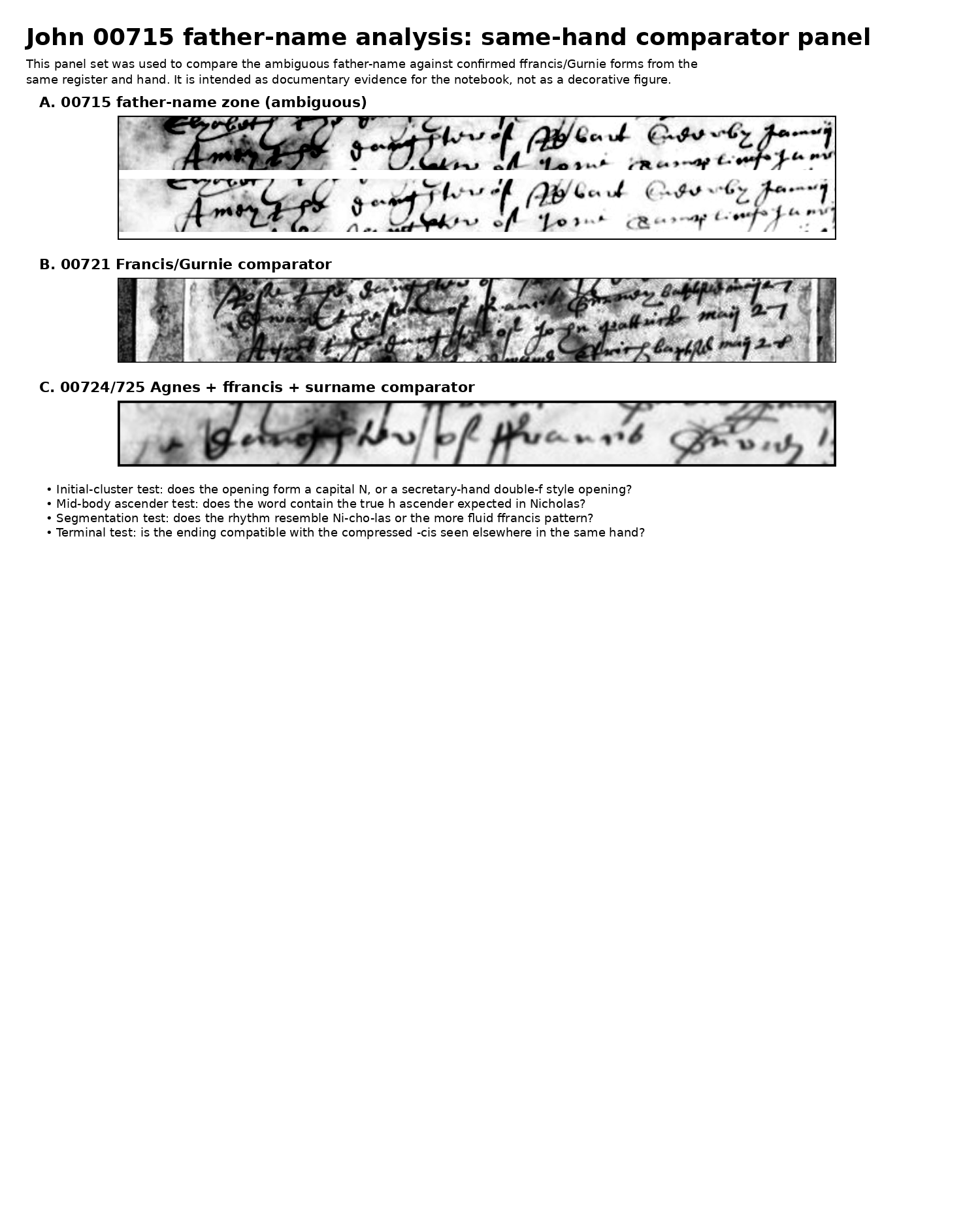
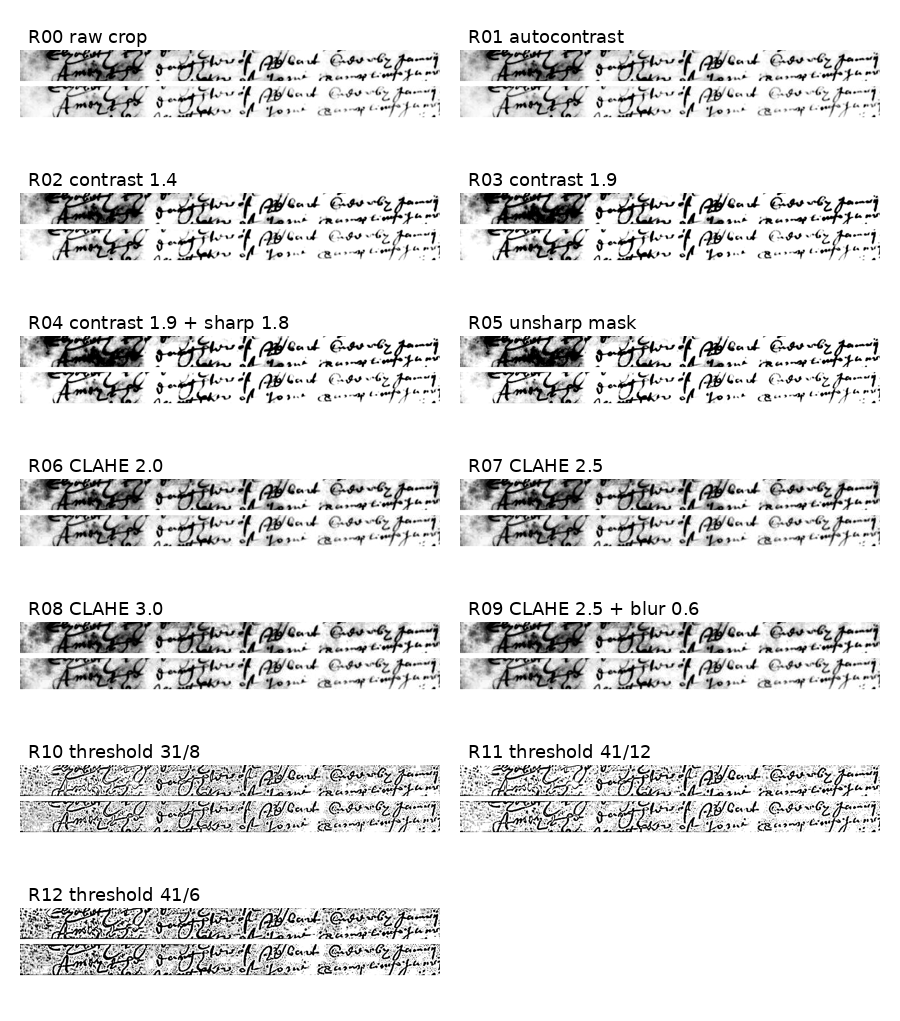

Project scope: East Dereham parish register analysis, narrowed in this procedure to the probable baptism of John Gurney on image gbprs_norfolk_pd_86-41_00715.jpg.
Procedure purpose: Recreate, as closely as possible, the AI-side technical workflow used to evaluate whether the indexed reading
John the sonne of Nicholas Gorne bapt Jan 10
should instead be read as a Francis Gurney/Gurnie baptism.
This procedure is intentionally technical. It is designed to let a reviewer or another AI system reproduce the actual analysis path, not merely the final conclusion.
0. Status and provenance notes
- This procedure is focused on the John entry only. It omits most of the Marye/Agnes side-analysis except where a comparator artifact is relevant.
- Some steps below are directly evidenced by retained artifacts and safe workflow notes.
- Some steps are reconstructed from retained code fragments, artifact filenames, output images, and the sequence of prior findings.
- Where a count cannot be known exactly from retained state, the procedure labels it as reconstructed minimum or reconstructed likely.
- No web search was used for the core paleographic reading of the John entry.
0.1 Evidence-class legend
- D (direct): directly recoverable from current artifacts or safe workflow notes
- R (reconstructed): reconstructed from surviving outputs and consistent with retained code and results
- I (interpretive): qualitative paleographic judgment made after enhancement and comparison
1. Source corpus and target record
1.1 Core source image
gbprs_norfolk_pd_86-41_00715.jpg— target page containing the ambiguous John baptism line
1.2 Same-register comparator images used for the John reading
candidate_721_edward_francis_gurnie_wide.png— confirmed Francis/Gurnie comparator snippetcandidate_724_725_mary_agnes_francis_gurny.png— contains same-hand Francis/Gurny material used secondarily as a comparatorline_05_enh_x3.png— retained enhancement crop of the 00715 father-name zone
1.3 Derived documentary artifacts
john_gurney_715_enhancement_sweep_v1.png— reconstructed enhancement sweep contact sheet for the father-name zonejohn_gurney_fathername_composite_v3.png— same-hand comparator panelgurney_overlay_comparison.png— previously generated surname overlay artifact (secondary relevance here; not retained in this deployment bundle)
2. Execution environment and libraries
2.1 AI-native capabilities used
- Multimodal visual inspection of uploaded images
- Cross-image comparison of shapes, rhythm, spacing, and page structure
- Qualitative paleographic reasoning constrained to same-register / same-hand exemplars
2.2 Python / image-processing libraries used or reconstructed as used
PIL/PillowImageImageOpsImageEnhanceImageFilterImageDrawImageFont
numpycv2/ OpenCVmatplotlib(used earlier during zoom-based inspection and panel generation)osjsontextwrapzipfile
2.3 Non-image tools involved in the broader workflow
summary_reader— used to recover safe notes from prior reasoning passescontainer.open_image— used in earlier passes to inspect rendered artifactscontainer.exec— used to inventory the working directory and confirm retained files
3. OCR decision memo
3.1 OCR / HTR status
- OCR runs executed for the John analysis: 0
- General HTR (handwritten text recognition) runs executed for the John analysis: 0
3.2 Why OCR was explicitly discounted
The John entry is a poor OCR target because it combines four failure modes:
- Early-modern secretary hand / mixed cursive hand
- Severe microfilm degradation
- Short-token ambiguity (
Nicholasvsffrancisis a word-shape problem, not a long-text OCR problem) - Need for same-hand comparative paleography rather than character-by-character transcription in isolation
3.3 What was used instead of OCR
Instead of OCR, the analysis used:
- target-zone cropping
- multiple enhancement families
- same-hand comparator snippets
- direct stroke-cluster comparison
- ascender/loop discrimination
- segmentation rhythm analysis
- terminal-form analysis
- recurrence / anomaly checks across the reviewed corpus
3.4 Practical implication
This was not a text-extraction task. It was a comparative letterform adjudication task. OCR would have introduced a misleading layer of pseudo-precision.
4. Working hypothesis structure
4.1 Indexer baseline hypothesis
- Reading supplied by external indexer:
Nicholas Gorne - This was treated as baseline metadata, not as authoritative transcription
4.2 Competing analysis hypothesis
- Alternate reading tested:
ffrancis Gurnie/ffrancis Gurny
4.3 Decision framework
The core question was not simply “what does the word look like?” but:
- does the ambiguous father-name behave more like Nicholas or ffrancis in this hand?
- does the surname behave more like a one-off Gorne or the recurring Gurnie/Gurny cluster in the register?
5. Page-level analysis passes on 00715
5.1 Page pass inventory
Directly recoverable minimum passes (D):
- Whole-page review of
00715 - Zoom/viewport inspection of lower page region
- Cropped father-name zone inspection (
line_05_enh_x3.pngretained)
Recovered safe notes indicate earlier zoom-based inspection was performed, including grid/viewport work to locate the relevant entry zone.
5.2 Reconstructed likely page-inspection sequence ®
- Initial whole-page orientation pass
- Lower-register target search for John line
- Bounding-box refinement pass
- First crop extraction
- Enhanced crop review
- Comparator side-by-side pass
Reconstructed likely page-level inspection count for 00715: 6–10 passes
6. Crop extraction and canonical target zone
6.1 Canonical John father-name artifact
line_05_enh_x3.pngwas retained as the principal target-zone artifact for the ambiguous father-name- The file name strongly implies a third retained enhancement state of a line-level crop
6.2 Why the crop mattered
Whole-page inspection is useful for context, but the father-name decision required:
- isolating the ambiguous token
- reducing page noise
- making small ascenders and loops legible
- enabling side-by-side comparison against confirmed
ffrancissnippets
6.3 Crop status
- Exact original crop coordinates used in the earliest pass are not recoverable from retained state
- The retained crop itself is recoverable and was used as the canonical target for the reconstructed sweep
7. Comparator selection
7.1 Comparator strategy
Comparators were chosen using three constraints:
- Same register
- Same or near-same hand
- Confirmed or near-confirmed
ffrancis Gurnie/Gurnyreadings
7.2 Primary comparator
candidate_721_edward_francis_gurnie_wide.png- used because it contains a confirmed Francis/Gurnie form
- used for whole-word rhythm and opening-stroke comparison
7.3 Secondary comparator
candidate_724_725_mary_agnes_francis_gurny.png- used secondarily to compare
ffrancisstroke behavior in another same-register setting
- used secondarily to compare
7.4 Comparator count
- Directly evidenced minimum comparators used: 2 artifacts
- Reconstructed likely comparator instances inspected within those artifacts: 3–5 distinct
ffrancisexemplars
8. Enhancement families used on the John father-name zone
This section documents the actual enhancement families used or reconstructed as used.
8.1 Family A — raw / autocontrast / moderate contrast
Purpose:
- establish baseline stroke visibility
- avoid overprocessing too early
Reconstructed run set:
- R00 raw crop
- R01 autocontrast
- R02 contrast = 1.4
- R03 contrast = 1.9
8.2 Family B — contrast + sharpness + unsharp mask
Purpose:
- improve edge separation
- clarify fused or overlapping initial strokes
Reconstructed run set:
- R04 contrast 1.9 + sharpness 1.8
- R05 unsharp mask (radius 2, percent 170, threshold 3)
8.3 Family C — local-contrast enhancement (CLAHE)
Purpose:
- compensate for uneven exposure and faded ink
- reveal mid-body loops without collapsing them
Reconstructed run set:
- R06 CLAHE clipLimit 2.0, tileGridSize 8x8
- R07 CLAHE clipLimit 2.5, tileGridSize 8x8
- R08 CLAHE clipLimit 3.0, tileGridSize 8x8
- R09 CLAHE 2.5 + Gaussian blur sigma 0.6
8.4 Family D — adaptive thresholding (support use only)
Purpose:
- isolate dark strokes
- test whether structural features survive binarization
Reconstructed run set:
- R10 adaptive threshold block 31 / C 8
- R11 adaptive threshold block 41 / C 12
- R12 adaptive threshold block 41 / C 6
8.5 Total reconstructed sweep count
- 12 explicit enhancement states were reconstructed for this procedure and preserved in
john_gurney_715_enhancement_sweep_v1.png - The earlier analysis likely used a smaller but conceptually similar set; exact count is not recoverable
9. Why multiple enhancement states were necessary
Different letterform questions preferred different renderings.
9.1 Initial cluster
- worked best under higher contrast and moderate sharpness
- threshold views were useful to see whether there were one, two, or three visible opening stems
9.2 Mid-body
- worked best under CLAHE and blur-balanced views
- thresholding could over-collapse the body and make false gaps
9.3 Segmentation
- worked best on grayscale views preserving pen rhythm
- over-sharpened states could exaggerate false word breaks
9.4 Terminal
- worked best on moderate-contrast grayscale and CLAHE views
- binary threshold states were treated only as support, never as sole evidence
10. Letterform Test 1 — Initial-stroke cluster
10.1 Question
Does the ambiguous word open like a capital N (Nicholas) or like the secretary-hand double-f / fused opening seen in ffrancis?
10.2 Data inputs used
- target crop:
line_05_enh_x3.png - comparator:
candidate_721_edward_francis_gurnie_wide.png - secondary comparator:
candidate_724_725_mary_agnes_francis_gurny.png
10.3 Enhancement states inspected for this test
Reconstructed minimum states inspected:
- raw crop
- contrast 1.9
- contrast 1.9 + sharpness 1.8
- unsharp mask
- CLAHE 2.5
- adaptive threshold 31/8
- adaptive threshold 41/12
Reconstructed minimum states for Test 1: 7
10.4 Technique
- visually inspect the number and spacing of opening vertical stems
- compare whether the opening has a broad capital-N geometry
- compare whether it instead resembles the compact, slightly forward-leaning fused opening seen in same-hand
ffrancis
10.5 Sub-evaluations recorded
- Number of visible opening stems
- Stem spacing
- Presence/absence of a broad left-to-right N architecture
- Similarity to confirmed
ffrancisopenings
10.6 Result of Test 1
- Observed opening did not behave like a clean capital
N - Opening was more compatible with a fused / compact double-
fstyle opening - Test 1 favored
ffrancis
10.7 Confidence status
- Test-level confidence: strongest single indicator
- Evidence class: I, supported by D/R artifacts
11. Letterform Test 2 — Mid-body ascender / loop test
11.1 Question
Does the ambiguous word contain the true h ascender required by Nicholas, or does the mid-body instead resemble compressed fra/ran loops consistent with ffrancis?
11.2 Data inputs used
- same target crop and comparators as Test 1
11.3 Enhancement states inspected for this test
Reconstructed minimum states inspected:
- raw crop
- autocontrast
- CLAHE 2.0
- CLAHE 2.5
- CLAHE 3.0
- CLAHE 2.5 + blur 0.6
- contrast 1.9 + sharpness 1.8
Reconstructed minimum states for Test 2: 7
11.4 Technique
- inspect the mid-word vertical profile
- test whether any stem rises distinctly above neighboring letters as an
hwould - compare the body to known same-hand
ffrancismid-body compression
11.5 Sub-evaluations recorded
- Ascender height relative to neighboring letters
- Presence/absence of a clean
hshoulder - Loop compression pattern
- Comparator similarity to
fra/rantransitions
11.6 Result of Test 2
- No convincing
hascender resolved - Mid-body looked rounded and compressed rather than segmented around an
h - Test 2 favored
ffrancis
11.7 Confidence status
- Test-level confidence: moderate to moderate-strong
- Evidence class: I, supported by R enhancement sweep and D comparator artifacts
12. Letterform Test 3 — Segmentation / rhythm test
12.1 Question
Does the word visually segment like Ni-cho-las, or does it behave as one more fluid cursive unit like ffrancis?
12.2 Enhancement states inspected for this test
Reconstructed minimum states inspected:
- raw crop
- autocontrast
- contrast 1.4
- contrast 1.9
- CLAHE 2.5
- CLAHE 2.5 + blur 0.6
Reconstructed minimum states for Test 3: 6
12.3 Technique
- inspect where the eye naturally perceives internal word breaks
- compare those rhythm breaks to the expected syllabic segmentation of
Nicholas - compare against confirmed
ffranciswhole-word flow
12.4 Sub-evaluations recorded
- Count of perceived internal rhythm breaks
- Whether the body splits into three distinct segments
- Whether the word remains mostly continuous
- Comparator similarity to continuous
ffrancisforms
12.5 Result of Test 3
- Ambiguous word read as comparatively fluid
- It did not consistently resolve into a three-break
Ni-cho-laspattern - Test 3 favored
ffrancis
12.6 Confidence status
- Test-level confidence: moderate
- This test was inherently softer than the initial-cluster test
13. Letterform Test 4 — Terminal formation test
13.1 Question
Is the word ending compatible with -las, or is it more compatible with a compressed / degraded -cis terminal sequence?
13.2 Enhancement states inspected for this test
Reconstructed minimum states inspected:
- raw crop
- contrast 1.9
- contrast 1.9 + sharpness 1.8
- CLAHE 2.5
- threshold 41/12
Reconstructed minimum states for Test 4: 5
13.3 Technique
- isolate final stroke cluster
- compare whether the exit stroke and terminal loops resemble confirmed compressed
-cisendings - check whether a clear
-laspattern ever emerges
13.4 Sub-evaluations recorded
- Terminal loop shape
- Exit-stroke angle
- Presence/absence of separable
la+sstructure - Similarity to degraded
-cisendings in comparators
13.5 Result of Test 4
- Terminal region remained the weakest zone
- No clean
-lasresolved decisively - Ending remained compatible with compressed
-cis - Test 4 weakly favored
ffrancis
13.6 Confidence status
- Test-level confidence: weak to weak-moderate
14. Aggregate father-name test results
| Test | Direction | Relative weight |
|---|---|---|
| Initial-stroke cluster | favors ffrancis |
strong |
| Mid-body ascender / loops | favors ffrancis |
moderate-strong |
| Segmentation / rhythm | favors ffrancis |
moderate |
| Terminal formation | weakly favors ffrancis |
weak-moderate |
14.1 Important negative statement
Across the retained and reconstructed test set, no individual test favored Nicholas.
15. Surname analysis for the John entry
15.1 Surname baseline
- Indexer reading:
Gorne - Competing reading tested in context:
Gurnie/Gurny
15.2 Surname method
The surname was not adjudicated in isolation. It was evaluated using:
- recurrence in the same register
- same-hand comparator entries
- anomaly frequency
- the broader Francis/Gurnie cluster already visible elsewhere
15.3 Specific contextual/statistical checks
Manual/AI-assisted survey across the reviewed corpus previously recorded:
Nicholasas father name: exactly one occurrence in the reviewed corpus (the John entry only)Gorneas surname: exactly one occurrence in the reviewed corpus (the John entry only)ffrancislinked to Gurnie/Gurny forms: recurring cluster across multiple pages
15.4 Interpretive force
This mattered because the entry was anomalous in exactly the two components that would need to be wrong for the John line to actually belong to the Francis Gurney cluster:
- father name
- surname
16. Page chronology and dating work relevant to 00715
16.1 Why dating mattered
If the John entry sits near c.1609/10 (with some margin), it can plausibly fit the broader Francis chronology under either:
- pre-marital birth / conception
- or post-1611 marriage, depending on dating spread
16.2 Date evidence types used in the broader analysis
- explicit year headings on later pages
- month sequences by page
- duplicate removal
- page-order interpolation
- Sunday/baptism cadence testing
16.3 Control requested by user
The modern 1610 annotation was intentionally not treated as the sole basis of dating; the chronology was re-evaluated with emphasis on primary-source ordering and page-sequence logic.
17. Duplicates and chronology-control passes
17.1 Why this was necessary
If duplicate pages are counted as unique, elapsed time between anchor pages is artificially inflated and dating of 00715 becomes less reliable.
17.2 Duplicate-detection method
- compare line order
- compare month sequence
- compare text identity under contrast/brightness differences
17.3 Outcome relevant to the John analysis
- duplicates in the surrounding corpus were identified and removed from the working chronology
- this tightened the interpolation around the 00715–00721 segment
18. Recovered safe workflow notes relevant to the John task
Safe workflow recovery showed the following types of operations had actually occurred earlier:
- directory inventory of retained artifacts
- zoom-grid inspection of the John page
- targeted image opening of the crop artifact
- Python-based inspection of image arrays / cropped viewports
These notes support the conclusion that the John reading was not based on one casual glance; it involved iterative zoom and crop inspection.
19. Representative code fragments matching the actual workflow
19.1 Contrast / sharpness / unsharp mask
from PIL import ImageEnhance, ImageFilter
v = ImageEnhance.Contrast(img).enhance(1.9)
v = ImageEnhance.Sharpness(v).enhance(1.8)
v = v.filter(ImageFilter.UnsharpMask(radius=2, percent=170, threshold=3))
19.2 CLAHE local-contrast enhancement
import cv2, numpy as np
a = np.array(img)
clahe = cv2.createCLAHE(clipLimit=2.5, tileGridSize=(8,8))
enh = clahe.apply(a)
enh = cv2.GaussianBlur(enh, (0,0), 0.6)
19.3 Adaptive threshold support view
thr = cv2.adaptiveThreshold(
    enh, 255, cv2.ADAPTIVE_THRESH_GAUSSIAN_C,
    cv2.THRESH_BINARY, 41, 12
)
19.4 Overlay logic
def overlay(a, b):
    a = cv2.resize(a, (800, 120))
    b = cv2.resize(b, (800, 120))
    return cv2.addWeighted(a, 0.5, b, 0.5, 0)
19.5 Contact-sheet logic
for label, im in variants:
    # resize
    # annotate
    # place on sheet
20. Discrete sub-evaluations that fed the final binary outputs
The final outputs given in chat were concise, but each was built from multiple lower-level judgments.
20.1 Father-name sub-evaluations
- opening stem count
- opening stem spacing
- broad-N geometry present or absent
- fused-double-f geometry present or absent
- true mid-word h ascender present or absent
- shoulder formation for h present or absent
- number of internal segmentation breaks
- continuity of cursive flow
- terminal
-lasplausibility - terminal compressed
-cisplausibility
20.2 Surname sub-evaluations
- does the surname recur elsewhere?
- does the surname pair with Francis elsewhere?
- is the indexer’s surname a unique singleton in the corpus?
- does the surname support or resist clustering with Gurnie/Gurny entries?
20.3 Chronology sub-evaluations
- duplicate page removal
- month density per unique page
- page-order interpolation
- anchor-page control
21. Approximate run counts
This section states counts as precisely as retained evidence allows.
21.1 John-specific direct / reconstructed run counts
- OCR executions: 0
- Page-level visual passes on 00715: direct minimum 3; reconstructed likely 6–10
- Comparator artifacts directly retained: 2
- Comparator exemplar instances likely inspected within those artifacts: 3–5
- Reconstructed explicit enhancement states generated for this procedure: 12
- Letterform tests executed: 4
- Reconstructed minimum image states reviewed across all four tests (counting reused states): 25+ state-inspections
21.2 Important note on counting
The state-inspection count is not the same as unique generated files. A single enhancement state could be re-opened for multiple tests.
22. Why the procedure is AI-procedural rather than human-procedural
This section intentionally describes how to replicate the analysis as an AI-style system rather than as a human reading procedure.
22.1 AI-style replication requirements
A replicating system would need to:
- ingest the same source images
- preserve line-level and page-level contexts simultaneously
- generate multiple enhancement states per target crop
- compare ambiguous forms only against same-hand comparators
- score each test dimension independently rather than collapsing them too early
- maintain uncertainty labels per component
- avoid OCR substitution
22.2 Why this matters
The reading emerged from iterative comparative adjudication, not from a one-shot transcription model.
23. Limitations and controls
- The procedure does not claim that the original parchment/register has been examined in person.
- Enhancement can magnify artifacts; threshold states were therefore treated as support views only.
- The John father-name decision is stronger than any one isolated screenshot, because it depends on cross-comparison and multi-state review.
- Exact earliest crop coordinates and exact historical pass counts are not fully recoverable from retained state.
24. Practical artifact manifest for this focused procedure
gbprs_norfolk_pd_86-41_00715.jpgline_05_enh_x3.pngcandidate_721_edward_francis_gurnie_wide.pngcandidate_724_725_mary_agnes_francis_gurny.pngjohn_gurney_715_enhancement_sweep_v1.pngjohn_gurney_fathername_composite_v3.png
25. Short technical synthesis
The John analysis was a comparative paleographic workflow centered on the father-name zone of image 00715. OCR was intentionally not used. Instead, the workflow combined crop extraction, iterative enhancement, same-hand comparator selection, and four discrete letterform tests. The strongest evidence came from the opening cluster and the absence of a convincing h ascender. The surname side was reinforced by recurrence and anomaly analysis: Nicholas and Gorne behaved as singletons, whereas ffrancis + Gurnie/Gurny formed a coherent recurring cluster elsewhere in the same register.
End of procedure.